‘Otaru’ is one of the leading tourist spots in Hokkaido with high popularity, and its symbol is the Otaru Canal. But what’s so special about the Otaru Canal? And how much tourism time should you set aside for it?
Otaru Canal, 小樽運河, Otaru Unga
Otaru Canal was a central part of the city’s busy port in the first half of the 20th century. Large vessels were unloaded by smaller ships, which then transported the goods to warehouses along the canal.
The canal became obsolete when modern dock facilities allowed for direct unloading of larger vessels. Thanks to a citizens’ movement, a part of the canal was beautifully restored in the 1980s instead of being landfilled, while the warehouses were transformed into museums, shops and restaurants.
The Otaru Canal is a ten minute walk or a two minute bus ride down the main road from Otaru JR Station.
The canal is about 1.1km long, so it makes for a pleasant stroll during the day on the promenade, when artists present their works to passing tourists, and during the evenings when old fashioned gas lamps are lit and provide a romantic atmosphere.
We started our stroll from one bridge to another. From the bridges, you’ve a beautiful view the warehouses, the canal, and the promenade. The 2 bridges are the Chuo Bridge and Asakusa Bridge.
View of Otaru Canal from Chuo BridgeView of Otaru Canal from Asakusa BridgeWe visited Otaru Canal in the cool 14.1*C autumn season.
You can’t give Sankaku Market a miss when you visit Otaru in Hokkaido. It is a down-to-earth marketplace with vendors selling fruits, veggies, seafood, and prepared seafood dishes in this wet market.
Otaru Station
Where is Sankaku Market
It is the closest tourist attraction (200 meters or about 2 minutes walk) to Otaru JR station. After exiting the station, turn left and walk up the stairs to the covered wet market.
Sankaku market is a short 200 meters and small fresh market. There are many seafood stalls and restaurants in the alley. The seafood stalls sell:
Raw salmon
King crab leg
Arabesque greenling
Atka mackerel
Surf clam
Oyster
Neptunea Arthritica
Ezo Neptune Whelk Winkle
More
Eat in Sankaku Market
There are a few restaurants in the market. In one of the restaurants, you can grab a crab and they’ll cook it for you on the spot!
Don’t forget Ajidokoro Taekda and Kita no Donburiya Takinami Shokudo in the middle of Sankaku market.
Alternatively, you can also create your own seafood rice bowl.
Choose rice bowl size: small or middle size
Choose 3 to 4 combinations out of 10 preferred toppings. Toppings are:
Salmon roe
Sea urchin
Crab
Tuna
Botan shrimp
Sweet shrimp
Salmon
Live scallop
Flying squid
Seasonal food
I created my own bowl and ate seafood rice bowl of sea urchin, crab, tuna, Botan shrimp, salmon eggs, salmon, live scallop for dinner at Takinami Shokudo.
When Ma Maison Ebisu at Lot 10, Bukit Bintang, Kuala Lumpur opened, I was first introduced to tonkatsu. What is tonkatsu? A Japanese dish of meat coated in breadcrumbs and fried.
All set meals come with rice, tonjiru (miso soup with pork), cabbage, and pickles:
Rosu Katsu (Deep Fried Pork Loin)
Hire Katsu (Deep Fried Pork Fillet)
Okonomi Katsu (Variety Katsu)
Iroiro Katsu (Assorted Katsu)
Rosu Katsu (Deep Fried Pork Loin with Cheese)Sakana Set (Deep Fried White Fish)
If you’re coming from Lot 10 parking lot, take the escalator or lift from the 5th, 6th, 7th, or 8th floor down to the 4th floor. But if you’re coming from the Bukit Bintang MRT or monorial, take the escalator or lift from the ground floor up to the 4th floor. The 4th floor is also known as Js Gate Dining, where there are only Japanese food on this level in Lot 10.
Then in 2019, when I was holidaying in Japan, I ate the tonkatsu at Tonkatsu Wako Pole Town, Sapporo, Hokkaido.
Sapporo TV Tower stands exactly in the heart of Sapporo, Hokkaido, Japan. The Sapporo TV Tower was built in 1957 and is a 147.2-metre-high (483 ft) TV tower with an observation deck at a height of 90.38 metres. It is located on the eastern end of Odori Park.
Sapporo TV Tower (さっぽろテレビ塔, Sapporo Terebi-tō)
¥720 admission fee
We visited Sapporo in the autumn of 2019. Due to time constrain, we could only tour the observation deck at night. Inasmuch the day time view was beautiful, the overarching and overlooking night time view was spectacular. See how Odori Park and Sapporo city light up at night!
View of Sapporo city at nightNight view of Odori ParkWhat you can view to the east of the Sapporo TV Tower
How to Get to Sapporo TV Tower
Traveling by subway or train?
Exit number 27 is a 5 minute walk from the Sapporo Municipal Subway Odori Station (Tozai line and Nanboku line)
Exit number 27 is a 1 minute walk from the Sapporo Municipal Subway Odori Station (Toho line)
A 15 minute walk from the JR Sapporo Station, South Exit.
Traveling by car?
15 minutes (4.572 km) from the Sapporo North Interchange expressway exit
Traveling by taxi?
5 minutes from the JR Sapporo Station (approximately 800 yen)
Autumn in Sapporo, Hokkaido, Japan. Escape from the hustle and bustle of city life, and enjoy some greenery at Odori Park.
Odori Park spans about 1.5 km and covers 78,901 square meters in the center of Sapporo. It stretches from east to west across 13 blocks of fountains, monuments, and gardens. The address is from Nishi 1 chōme, Ōdōri to Nishi 12 chōme, Ōdōri.
“Nishi” means west, and “chōme” is a block in Japanese
On the eastern end of the park is the Sapporo TV Tower. On the western end is the Sapporo Archives Museum (Former Sapporo Court of Appeal).
Odori Park divides the city into north and south sections.
Odori Park at 1:00pm in autumnSapporo TV TowerView of Odori Park at night from the Sapporo TV Tower
Today I’m brought back to NUDE Seafood. NUDE Seafood is a seafood restaurant in Marina One East Tower in Singapore.
How to get to NUDE Seafood
If you’re taking the MRT and depending on which line you’re on; stop at either Downtown station (DT17) or Marina Bay station (CE2/NS27). Then walk up towards Marina One East Tower.
What I Ate (In 2017)
I stripped them seafood nude. Throwback to 2017, it was a set dinner. Hence, some items may not be available already.
Baby SquidManila ClamsGolden PomfretOcean TroutSorbetPolar BearChocolate Blueberry and Thyme
Now that borders are open (again), it is time to visit the Lion City – Singapore! If this is your first time in Singapore or back in Singapore since the start of the pandemic two years ago; much would’ve changed in Singapore.
No doubt, the first places to visit will be the touristy spots. Self-planning a trip is no easy feat and Singapore is no exception. Despite being an island nation, there is still so much to cover and explore. Here’s a throwback itinerary to my family’s Singapore trip in 2017. Even though the photos are from 2017 but they hold memories and the places visited are still relevant today.
I hope you find this 4 days itinerary useful and have a pleasant trip in Singapore.
DAY 1
To get the most out of a short trip, the best will be to book an early morning flight. Flying in from KLIA2, we touched down in Changi Airport in Singapore at about 9:35am.
Getting around Singapore is very convenient with their efficient public transport system. We bought the SMRT ez-link card. $20 is more than enough for 3 to 4 days travel within the city center.
Can you believe it?! Star Wars: The Last Jedi came out in 2017! That’s how far we’ve come!
Star Wars ez-link card
Anyway, we wanted to head to the hotel first. We took the train from Changi Airport (CG2) on the East West Line to the Expo (CG1/DT35), and then changed onto the Downtown Line towards Bencoolen (DT21). Just outside of Bencoolen MRT and a short 2 minutes walk was our hotel – V Hotel Bencoolen – for the next 4 days.
For a 3 nights stay, it was SGD$651, so for a 3 person family for 3 nights, it was SDG$217 per person per night.
View from the V Bencoolen HotelView from the hotel
After checking-in into the hotel and exploring the view, we were back to our holiday outside. From Bencoolen, we continued down the Downtown Line to Chinatown (NE4/DT19).
After lunch and jalan-jalan in Chinatown, we went on to Merlion. We passed PARKROYAL COLLECTION Pickering and walked along Boat Quay and the Singapore River. Here, it reminded me of the Malacca River at Jonker Street in Melaka, Malaysia; just that now we’re in Singapore.
Merlion
Left and Right views of Merlion
We crossed Esplanade Bridge. At 3:00pm, we stopped for our tea break at Suzette at Makansutra Glutton’s Bay.
After a fulfilling dinner, we journeyed back up to Bencoolen from Downtown (DT17). We ended our first day and night at V Bencoolen Hotel.
DAY 2
Orchard Road
We started the day and our morning along Orchard Road. At Orchard Central, you’ll find a touch of modern in Orchard Central and a trip back to past across the mall and along Emerald Hill Road.
Orchard Central in 2017Apple Orchard RoadShophouses in Emerald Hill Road
After lunch at Orchard Road, we took the MRT from Orchard (NS22) and rode down the North-South Line towards Marina Bay MRT (NS27). We walked to the Marina Bay Waterfront Promenade. There it was, a beautiful panoramic view of the bay area. It’s another picturesque spot.
The next stop on the itinerary was the Marina Bay Sands SkyPark. After purchasing the ticket, take the elevator up to the observation deck. The SkyPark Observation Deck is at level 56. In 2017, tickets costed SGD$23 per person.
From the observation deck, you’ve a beautiful overview of the bay and it’s surroundings. You can see how smooth the flow is from the central business district to the arts, entertainment, and leisure area, and then nature and greenery on the other end.
You can enjoy a meal and drink on the deck.To the West and South are views of the Promontory @ Marina Bay and the office towers towering over the bayTo the NorthWest is views of the Esplanade, Fullerton Road, museums and beyondTo the North is The Float @ Marina Bay, The Ritz Carlton, The Esplanade, Raffles and beyondTo the East is the view of Gardens by the Bay and Singapore StraitTo the North is the Singapore Flyer
ArtScience Museum
Just below SkyPark and next to Marina Bay Sands is the ArtScience Museum: design, science, and technology exhibits in a distinctive, modern, flower-shaped building.
So, 3:00pm at the ArtScience Museum and 4:00pm onwards at Gardens by the Bay. We bought the Standard 2 Conservatories + Christmas Wonderland bundle, which was then priced at SGD$31.00 per person.
This is a throwback to Gardens by the Bay in December 2017. I wonder how will be the Christmas theme in December this year?
Festive Market @ Supertree GroveSupertree Grove in the eveningSupertree Grove at night
Supertree Grove light show
We stayed back at night and enjoyed the themed light and music shows. Choreographed bayside spectacles of coloured lights set to classical music, pop songs, and show tunes.
DAY 3
Little India
From Bencoolen, we took the MRT down to Chinatown, and then switched onto the North East Line from Chinatown to Little India.
Umbrella Park
After spending the morning and early afternoon in Little India, we made our way to Harbourfront. We took the MRT down from Little India to Harbourfront.
HarbourFront and VivoCity
At the heart of family-friendly Harbourfront is the massive VivoCity mall, which has a scenic rooftop playground and monorail access to recreation on Sentosa Island. Sentosa-bound cable cars depart from Mount Faber, home to hilltop bars and eateries, while the Singapore Cruise Centre offers trips to the Indonesian islands of Batam and Bintan.
After spending the better part of the afternoon in Vivocity and Harbourfront, we took the MRT up to Clarke Quay on the North East Line.
Clarke Quay
Clarke Quay is a historical riverside quay in Singapore. There is a mall with restaurants and nightlife in the redeveloped, 19th-century, riverside commercial district. Clarke Quay reminded me of the Malacca River at Jonker Street back in Melaka, Malaysia.
Clarke Quay during the dayClarke Quay JettyInside Clarke Quay
For the past few days, we always had breakfast near the hotel. On our last day here, we had breakfast at Food Republic, which was just few doors down from V Bencoolen Hotel.
It was time to check-out from the hotel and go back to Changi Airport the same way we came. We took the MRT from Bencoolen (DT21) on the Downtown Line to the Expo (CG1/DT35), and then continued to Changi Airport (CG2) on the East West Line.
Changi Airport
Let’s not forget the first tourist attraction when touching down into Singapore and the last attraction when departing from Singapore.
Last Sunday, on the way back from Ipoh to Kuala Lumpur, we decided to make a short detour and visit Kellie’s Castle. Kellie’s Castle (Kellie’s Folly) is located near Batu Gajah, Ipoh, Perak, Malaysia. The unfinished, ruined mansion, was built by a Scottish planter called William Kellie Smith. According to differing accounts, it was either a gift for his wife or a home for his sons.
Kellie’s History
William Kellie Smith was from a village in Scotland known as Kellas. In 1890, at the age of 20, he arrived in the then undeveloped Malaya. Here, he met an estate owner called Alma Baker, who had won concessions from the state government to clear 360 hectares of forests in Perak. With the substantial profits made from his business venture with Alma Baker, Smith started planting rubber trees and dabbled in the tin mining industry. In time, he became the owner of Kinta Kellas Estate and the Kinta Kellas Tin Dredging Company.
Now with his fortune made, he returned home to marry his Scottish sweetheart, Agnes, and brought her over to Malaysia in 1903. The following year, the couple was blessed with a daughter whom they named Helen. For many years after that, Agnes tried to conceive, but to no avail. William Smith desperately wanted a son and heir to take over his empire in the Malay Isles. After many years, Agnes finally gave birth to a son, Anthony, in 1915. The birth of his child was the start of even greater success for William Smith. To celebrate Anthony’s birth, William Smith decided to expand on his mansion. Smith started planning for a huge castle which he planned to call Kellas House, after his hometown in Scotland.
Construction Begins
Because of his fascination with the Hindu religion and the Indian culture, Smith’s plan was for this house to share similar architecture to those of Madras, with all its bricks and tiles imported from India. He even employed a big group of Indian labourers to build his dream house, to keep the Kellas House authentically Indian. The mansion is accessible from the main road through a bridge running across a stream.
But it was not only the cost of importing material and labourers from abroad that made the house so fascinating to locals and travellers alike. Among the many amazing things about Kellie’s Castle are an elevator (it was the first in Malaya) which connects right up to the top floor, and the existence of two tunnels that run under the river nearby. One of these tunnels connects to the Hindu temple some distance away from the main house.
On the second floor, Smith planned to build an indoor tennis court – an ambitious project even by today’s standards. On the highest floor, there is a rooftop courtyard for parties. This castle was to be the hub for entertaining wealthy colonial planters who had settled in Malaya. His house was so unique that it was even mentioned in the London Financier newspaper on 15 September 1911.
Construction Difficulties and Smith’s Death
Unfortunately for Smith, tragedies struck soon after the construction of the Kellas House began. A virulent strain of the Spanish flu spread from Europe to soon after World War I ended in Europe, killing many of the workers in the Kellas Estate. Another seventy workers constructing Smith’s dream castle also became victims of the flu. Smith, who had already spent a fortune on his house, lost a lot of money because of this.
In the end, Kellas House, later known as Kellie’s Castle or even Kellie’s Folly to some, was never completed. William Kellie Smith himself died of pneumonia during a short trip to Portugal in 1926. His heartbroken wife decided to pack up and return home to Scotland selling the estate and Kellie’s Castle to a British company called Harrisons and Crossfield.
Today…
All these years faded into memory, the castle has been reconditioned to serve as a visitor spot and enjoy the scenery and breeze at the rooftop. Descendants of the Tamil labourers brought over to Malaya to work on the mansion still live nearby even now. Kellie’s castle is now a popular local tourist attraction and was used as a setting in the 1999 film Anna and the King.
Kellie’s Castle is a beautiful place for graduation, wedding, and romantic photography. Albeit the ruins, its these ruins that provide the backdrop.
Sadly, there was no lift but the lift shaft was visible. We walked our way to the top of this four storey mansion. It was a good exercise. It’s definitely not for the faint hearted, not just from the walking but from the view too. There are no proper fencing and safety feature, so we had to thread extra cautiously and not do anything crazy. Nevertheless, the view was breathtaking. The view overlooked the river, the highway, the plantations, and lush greenery nearby. Its a sight to behold with your own eyes.
I can’t believe another 365+ days have so quickly passed… We’re now in the final minutes of 2016! Before venturing into 2017, let’s do a year in review for 2016. I’ve visited many new cafes and restaurants, and revisited many of those “new” cafes and restaurants. I’ve cafe hopped from cafe to cafe, and dined at various restaurants.
These are the places I’ve eaten and drank in 2016.
Fluffed Cafe and DessertFluffed Cafe and Dessert
Moim Modern Korean Cuisine
Dae Jang Gum
Antipodean CafeAntipodean CafeAntipodean Cafe
Streat Thai
Breakfast ThievesBreakfast Thieves
Inside Scoop
Bubba Gump Shrimp Co
Sid’s Pub
Was very blessed to have the opportunity to travel to London and Oxford in the United Kingdom this year September. Miles away from home for a short period of time. Different culture. Different food. Wholesome experience. The slideshow below is a summary and snapshot of the foods I ate in the UK. Happy sliding!
All in all, it was a fruitful and foodie year. You’ve just tasted the variety of cafes and restaurants I went to in January 2016 to December 2016, from top to bottom here. Visit my Facebook: FoodyFans and Instagram: foodyfans for more foodie pictures! I look forward to MORE and EXCITING cafes and restaurants to hop, visit, taste, drink, and eat. May 2017 be A MORE fruitful and foodie year for FoodyFans!
This the season for kdramas – Uncontrollably Fond, Doctors Crush, Another Oh Hae Young, and W. With all the craze about the hot actors and beautiful actresses, awesome attractions (Jeju Island), and kdrama love stories; let’s not forget Kfood. Fancy feeling close to Korea? Here are some Korean eateries to check out in Petaling Jaya.
Dae Jang Gum
Dae Jang Gum is a Korean BBQ Restaurant. It is presently located in Seksyen 14, Petaling Jaya. Previously, when we went there for lunch, the restaurant was at SS4D, Kelana Jaya.
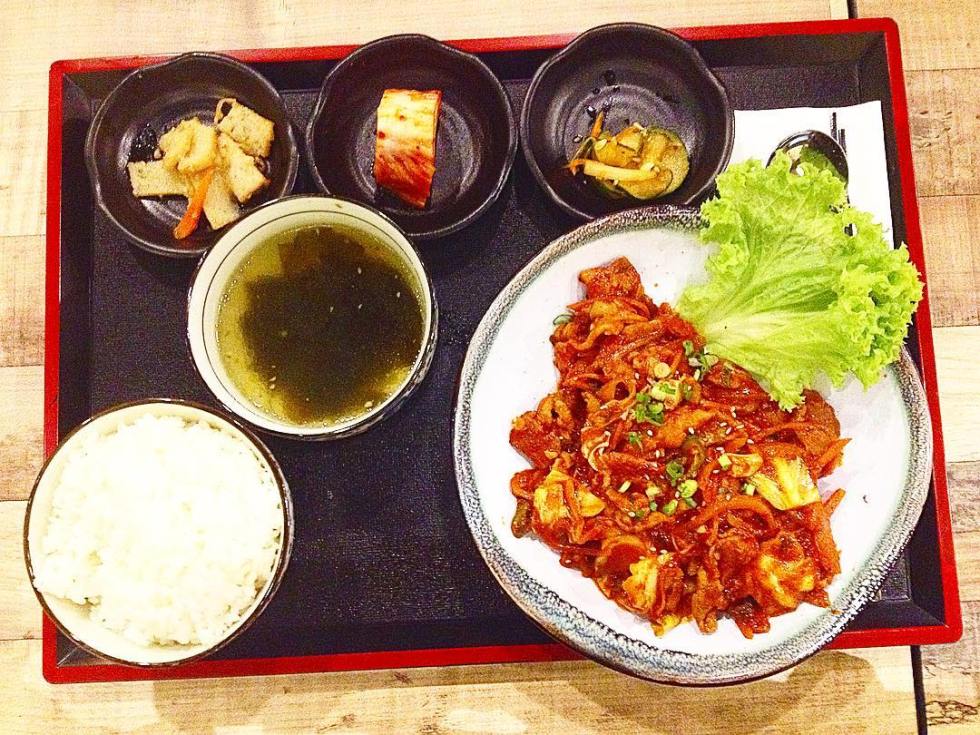
One Sunday afternoon, after church, my friends and I went for lunch at SS4D. Albeit being a Korean BBQ Restaurant, we were intrigued by its set lunch menu FOR RM14 & RM17. We ordered their pattaya fried rice set, bulgogi set, and dak dulgogi set.
At the sound of RM17, it sounds somewhat hefty and pricey on hindsight. However, they were definitely worthwhile, because of their quality and quantity. Quality was Korean standard. Quantity was due to their humongously many side dishes. On top of that, rice and soup were also provided.
We left with a Korean tastebud, a satisfied stomach, and a lighter wallet.
Fancy some Korean food for dinner? There’s a Korean Food stall in the East Wing of the Neighbourhood Food Court in Kota Damansara. Going by its name, it only and literally served Korean food. It focuses mainly on ala carte dishes. It’s Kimchi Jigae and Pork Bulgogi were delicious, satisfying, and fulfilling. The Kimchi Jigae was spicily cold. There were a lot of pork in the Pork Bulgogi.
Moim Modern Korean Cuisine
Want to eat your Korean food in a little bit more comfort? Then, head on over to Moim Modern Korean Cuisine in Atria Shopping Centre. There’s air-con and more comfy chairs. Of the 3 Restaurants listed in this post, THIS Korean restaurant is #1 in terms of originality. “Originality” here is by way of the amount of variety of dishes listed on the menu. There were a variety of Korean food which I’ve not seen or heard before… This is what makes this particular restaurant the most unique.
All in all, despite it being commonly termed as Korean food, I only consider it “true” Korean food when it has met this ONLY criteria. The chef has to be a Korean. This adds more flavour, meaning, and attachment to the Korean food. Therefore, this brings me closer to Korea. Annyeong!!

 Booking.com